
A creative director I spoke with recently had spent three weeks comparing AI tools. Transcription platforms, content generators, project management add-ons, the lot. By the end she had a spreadsheet with forty options and no more clarity than when she started. What she did not have was a clear picture of where any of it would actually fit inside how her studio already worked.
This is the possible trap. The market pushes you toward the tool decision first, when the tool decision should come almost last. Before you compare anything, you need to know which parts of your business are draining time and attention, and which of those are genuinely suited to being handed off. That is not a technical question. It is a question about how your work actually flows, and you already hold the answer.
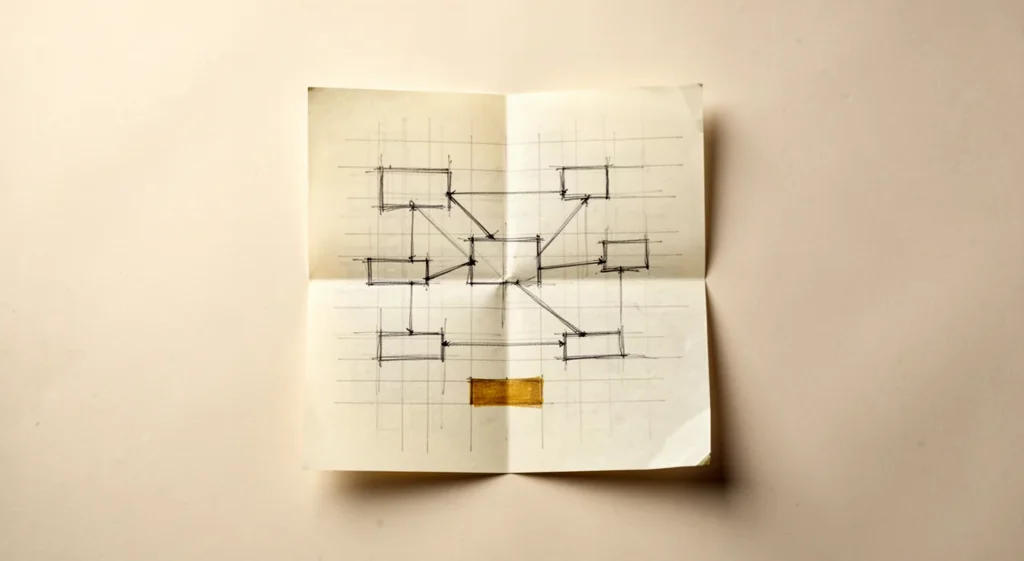
Here is a simple way to find it. It takes about thirty minutes, needs nothing more than a pen and paper or a blank document, and requires zero knowledge of how any AI tool works.
Step one: list the repeating work
Write down every task in your business that happens on a regular rhythm. Daily, weekly, monthly. Not the one-off projects, not the creative judgement calls, just the things that recur. Writing meeting notes. Chasing invoices. Formatting proposals. Sorting the inbox. Drafting first versions of recurring reports. Onboarding a new client. Resizing assets for different channels.
Do not filter yet. The goal is to see the repeating work laid out in one place, which most people never actually do. Aim for fifteen to twenty items. You will be surprised how quickly the list fills.
Step two: score each task on two questions
Go through the list and give each task two quick scores, one to five.
The first question: how often does this happen, and how much time does it eat? A task that takes ten minutes but happens twenty times a week matters more than one that takes an hour once a month. Score the total drain, not the single instance.
The second question: how much does this task depend on your judgement, your taste, or your relationships? A first draft of a status report depends on very little of that. A pitch to a client you have known for eight years depends on almost all of it. Score five for tasks that are pure human judgement, one for tasks that are mostly mechanical.
Step three: find the overlap
Now look for the tasks that score high on the first question and low on the second. High time drain, low dependence on your judgement. That overlap is where AI belongs first.
These are the tasks that cost you hours every week and lose nothing when a machine handles the heavy lifting, because they were never where your value lived in the first place. The first draft of a transcript. The initial sort of an inbox. The formatting pass on a document you will still review. The rough version that you then shape with the judgement only you have.
You are not looking to automate the work that makes you good. You are looking to clear the work that sits in front of it.
Why three, and not twenty?
Take the top three from that overlap. Just three. Not because you cannot do more later, but because starting with three keeps the whole thing legible. You can see whether each one actually saved time. You can adjust. You keep your footing.
The studios that struggle with AI are usually the ones that tried to change ten things at once and could no longer tell what was helping and what was quietly making things worse. Three is small enough to stay honest with yourself about the results.
And here is the part the tool comparisons never mention. Once you have your three, the vendor conversation becomes simple. You are no longer asking “what can this platform do?” You are asking “does this do the specific thing on my list, well enough to trust?” That is a question you can answer in an afternoon, because you defined the need before you went looking for the solution.
What the audit really shows you
The most useful outcome of this exercise is often not the three tasks themselves. It is the shape of your own week, seen clearly for the first time. Most people carry a vague sense that certain work is eating their time without ever naming exactly what. The audit turns that fog into a list, and a list is something you can act on with a clear head.
You may finish it and decide the top task is not worth automating at all, that it is actually a hiring question, or a process question, or something to simply stop doing. That is a good outcome too. The point was never to reach AI. The point was to see your work plainly enough to make a real decision.
Which raises a question worth sitting with. When was the last time you looked at the whole of your week laid out in one place, not to judge it, but just to see it?