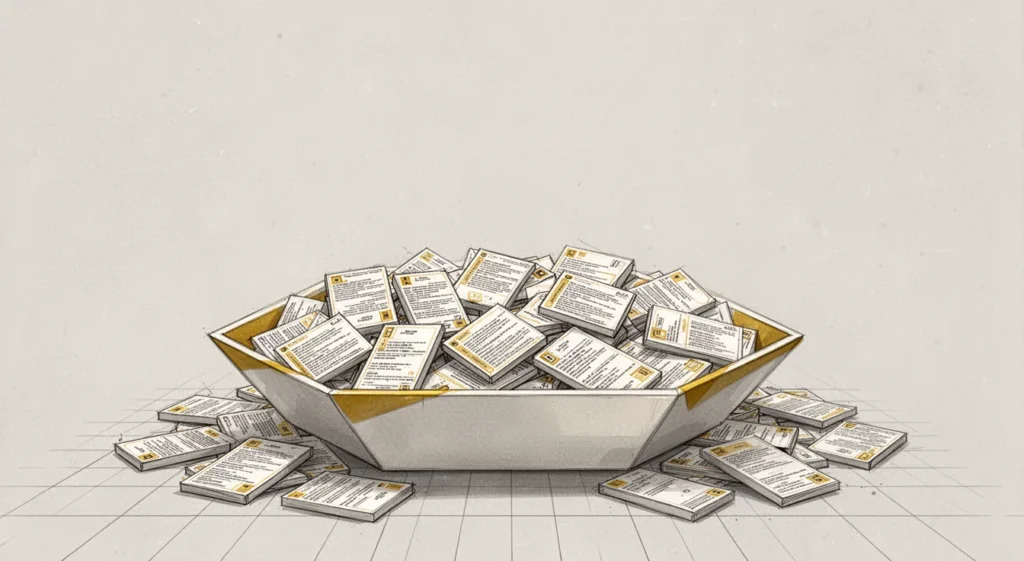
Picture a strategist on a mid-sized brand team. She tells you about a Monday that has stayed with her. She opened her inbox to find three documents waiting for review. A competitor analysis, a first-draft campaign narrative, and a set of audience personas. All three were well-formatted. All three read fluently. All three had been produced on that last Friday, in a fraction of the time they would once have taken, by colleagues using AI tools the agency had recently rolled out.
By lunchtime she had a problem she could not quite figure out. The documents were not wrong, exactly. But they were not right either. The competitor analysis described the market in confident, generic terms that could have applied to almost any category. The personas were plausible people who did not seem to correspond exactly to anyone the brand actually served. The campaign narrative was smooth and said very little. Nothing was broken. And yet she now had to read all three carefully, question each one, and in most cases rebuild them from a more honest starting point.
She had received more work than before. She was getting less done.
The output looks finished. That is the problem.
For most of the history of knowledge work, the effort required to produce something was a rough signal of its seriousness. A polished ten-page document meant someone had spent real time on it. A set of personas meant someone had thought about the audience. The finish of the work used to tell you something about the thinking behind it. Not perfectly, but reliably enough that you could use it as a shortcut.
That link has quietly come apart. AI can now produce the finish without the thinking. It can generate the ten pages, the clean formatting, the confident tone, the reasonable-sounding structure, in minutes, and it can do this whether or not any genuine judgement sits underneath. AI now separates the surface of the work from the substance underneath.
This is what the phrase “workslop” points at. It is not bad work in the old sense. Bad work used to look bad. You could see the rushed formatting, the thin argument, the gaps. Workslop looks good. It is fluent, structured, and superficially complete. What it lacks is on the inside: the specific insight, the real understanding of the client, the load-bearing judgement that separates a document that informs a decision from one that merely occupies a slot in a workflow.
The risk for creative and brand-led businesses is not the one that gets discussed most. It is not that AI will replace the people who do this work. It is that AI will flood the space around those people with output that looks like their work but was not actually thought through, and that someone, somewhere, still has to catch it.
Where the cost actually lands
Here is the part that is easy to miss when you are looking at productivity in the aggregate. When a tool makes it faster to produce something, the person producing it feels faster. Their part of the process genuinely sped up. The competitor analysis that took a day now takes an hour. From where they sit, this is exactly what the tool promised.
But work in an agency or a brand team does not stop at the point of production. It moves. It gets reviewed, questioned, integrated, presented, built upon. And the cost of loose, plausible, not-quite-right output does not disappear when the document is finished. It moves downstream, to whoever has to work with it next.
The strategist with three documents on Monday morning is carrying the cost that three colleagues quietly passed off on Friday. The effort did not vanish. It relocated, and it grew on the way, because catching a subtle problem in someone else’s confident-looking work is harder and slower than doing the thinking cleanly the first time.
This is the pattern worth watching. AI can make the visible, measurable part of work faster while pushing the invisible, harder-to-measure part, the reviewing, the sense-checking, the judgement, onto fewer people and into less time. The organisation feels more productive when it creates, but less productive when it has to decide. And because the strain lands on the people whose job is discernment, it lands exactly where a creative business can least afford to lose sharpness.
Why plausible is more dangerous than wrong
A wrong document is, in a strange way, easy to deal with. The error announces itself. Someone spots it, flags it, and it gets fixed. The system has an immune response to being obviously wrong.
Plausible is different. Plausible slips through. A set of personas that sounds reasonable but is not grounded in your actual audience will not trip any alarms. It will get referenced in a brief. The brief will shape a campaign. The campaign will be built on an understanding of the customer that no one ever actually verified, because the document describing that customer looked finished and confident and no one had the bandwidth to interrogate it.
The damage from plausible-but-hollow work is not a single visible failure. It is a slow drift. Decisions get made on foundations that were never load-tested. The work stays smooth on the surface while becoming less connected to anything true underneath. And by the time the drift shows up in results, it is very hard to trace back to the weekend when three fluent documents entered the system unexamined.
This is why the volume matters. One unverified document is manageable. A tool that lets every person on the team produce three of them, faster than anyone can review them, changes the arithmetic. The bottleneck in creative work was never production. It was judgement. And judgement does not scale the way generation does.
The question that actually helps
It would be easy to read all of this as an argument against the tools. It is not. The strategist’s colleagues were not doing anything foolish. They were using a capable tool to move faster, which is precisely what they were encouraged to do. The problem was not the tool and not the people. It was that no one had decided what the tool was for.
When a team adopts AI without a shared answer to that question, the default answer fills in on its own, and the default answer is almost always “produce more, faster.” That is the path of least resistance, because production is the part that feels like progress. So the team optimises for the thing that was never the constraint, and the real constraint, the finite human capacity to review and judge, gets quietly overwhelmed.
A more useful question sits one level up. Not “how do we produce more?” but “where in our work does volume actually help us, and where does it hurt?” These are not the same everywhere. There are parts of creative work where more raw material is genuinely valuable: early ideation, exploring directions, generating options to react against. Nobody minds twenty rough concepts when the point is to find the two worth developing. Volume is a feature there.
And there are parts where volume is the enemy. Anything that will be treated as settled, as a foundation others build on, does not benefit from being produced faster if the speed comes at the cost of it being properly thought through. A competitor analysis, a positioning statement, an audience understanding: these are decisions dressed as documents. Their value is entirely in the judgement they carry, and that judgement is exactly the thing AI cannot supply on its own.
The businesses navigating this well are not the ones with the strictest rules about AI. They are the ones that have quietly sorted their work into these two categories. Where volume helps, they let the tools run. Where volume hurts, they keep a human clearly and visibly on the hook for the thinking, and they make sure that person’s judgement is treated as the point of the work rather than an obstacle to shipping it faster.
Restoring the signal
Underneath all of this is something worth naming directly. The old link between effort and seriousness was doing quiet work in every team, and now that it has broken, teams have to replace it deliberately.
In practice this looks less dramatic than it sounds. It means a team getting clearer about what “done” actually means for a given piece of work, and separating “looks done” from “is done” out loud. It means someone being willing to ask, of a fluent document, a simple and slightly uncomfortable question: what specifically here did a person decide, and what did the tool decide for us? Not to catch anyone out. To restore the signal that the finish of the work used to carry for free.
It also means resisting a subtle pressure. When production gets cheap, there is a pull to treat review as the expensive, slow, old-fashioned part, the bottleneck to be minimised. That instinct is exactly backwards for a business whose value is judgement. In a world where anyone can generate plausible work, the ability to tell the difference between plausible and true becomes more valuable, not less. It is worth protecting the time and the people that make that discernment possible, even, especially, when the tools are whispering that you could just ship it.
The strategist eventually rebuilt all three documents. The versions that reached the client were sharper than anything the team had produced before, partly because the AI-generated drafts gave her raw material to react against. The tool helped. What it could not do was be the last set of eyes. That was still her, and the quality of the final work rested, as it always had, on the fact that someone with real judgement had actually looked.
The useful question for any creative business right now is not whether to use these tools. It is a quieter one. As production gets faster and cheaper, what is happening to the part of your work that was never about production at all, and who, exactly, is still carrying it?
Most teams already sense where their real judgement lives. It is usually in a few people, a few kinds of decision, a few moments where someone with experience says “not quite” and means something specific by it.